
Khwaja Nizamuddin Auliya
Who was Khwaja Nizamuddin Auliya?
The information in this brief biography came from Wikipedia
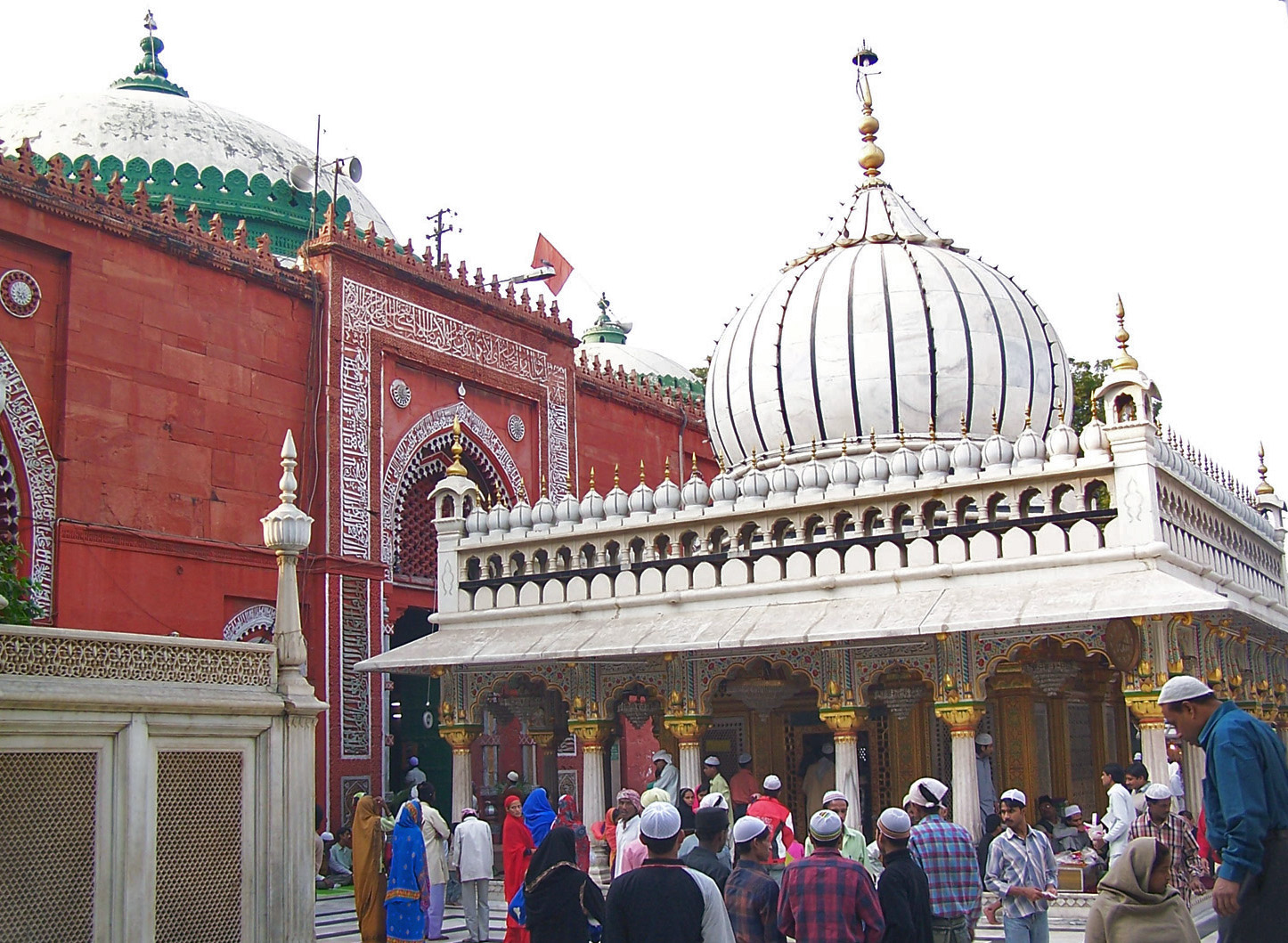
Khawaja Syed Muhammad b. Ahmad Ali al-Badaoni al-Bukhari, popularly called Nizamuddin Auliya (sometimes spelled Awliya; 1238 – 3 April 1325), also known as Hazrat Nizamuddin (lit. 'Holy Nizamuddin'), Sultan-ul-Mashaikh (lit. 'Lord of the pious') and Mahbub-e-Ilahi (lit. 'Beloved of God'), was an Indian Sunni Muslim scholar, Sufi saint of the Chishti Order, and is one of the most famous Sufis from the Indian subcontinent.
His predecessors were Fariduddin Ganjshakar, Qutbuddin Bakhtiyar Kaki, and Moinuddin Chishti, who were the masters of the Chishti spiritual chain or silsila in the Indian subcontinent.
Nizamuddin Auliya, like his predecessors, stressed love as a means of realising God. For him his love of God implied a love of humanity. His vision of the world was marked by a highly evolved sense of religious pluralism and kindness. It is claimed by the 14th century historiographer Ziauddin Barani that his influence on the Muslims of Delhi was such that a paradigm shift was effected in their outlook towards worldly matters. People began to be inclined towards mysticism and prayers and remaining aloof from the world.
"A Butcher in Delhi", a story from Nizamuddin Auliya
From the book: "Nizam Ad din Awliya, MORALS FOR THE HEART", Translated and Annotated by Bruce B. Lawrence, with a Foreword by Pir Zia Inayat-Khan
A BUTCHER IN DELHI WHO WAS AMONG THE SAINTS OF GOD. “Numerous people obtined blessings from him. Qazi Fakhr ad-din Naqila, early in his life, said to come to see him often. Once that butcher asked, ‘What do you want?’ Replied (the future) Qazi Fakhr ad-din: ‘I want to be Qazi (a judge or magistrate in Islamic law).’ ‘Go, replied the butcher, ‘you will become Qazi.’
“After this the master said: “There was another man who used to come to this Qazi. Once of him also the butcher asked, ‘Is there something that you desire?’ ‘What I desire,’ replied the man, ‘is to become Chief Justice.’ To that man also he said, ‘Go! You will become Chief Justice.’ And that man became Chief Justice.’
”Then the master said, “Maulana Wajih ad-din Husam also came to see that butcher and to him was put the same question: ‘What do you seek?’ Maulana Wajih ad-din replied: ‘I seek knowledge.’ And knowledge was granted him.
Still another man was acquainted with this butcher. One day the butcher asked of that man: And what do you want?’ ‘What I need,’ replied the man, ‘is to be bound by the love of God.’ And that man is among those have attained union with God (wasilan-i haqq).”
Then the master — may God remember him with favor — declared: “I too have seen that butcher.”
A Story: Amir Khusrau and the shoes of Nizamuddin Auliya
(From Pir Zia's Foreward)
Legend relates that a provincial farmer, reduced to ruin by a devastating drought, bethought himself of the fabled generosity of Hazrat Nizam ad-Din. In a flight of desperation he undertook the long journey to Delhi, hoping against hope for a windfall from the hand of the Sultan of Saints.
It was Hazrat Nizam ad-Din’s custom to pass on to the needy whatever he received in the way of donations from devotees. Nothing, down to the smallest sack of rice, was retained overnight at the saint’s lodge. Alas, on the day of the farmer’s appearance the cupboards were bare.
Hearing the farmer’s account of his crushing misfortune, Hazrat Nizam ad-Din could not bear to dismiss him empty-handed. With nothing else to offer, he unfastened his sandals and made the suppliant a present of them. The farmer mumbled polite acknowledgments and took his leave as his heart sank in his breast. Shoe leather would not feed his hungry children.
On the way home, the dejected farmer stopped for the night at a roadside caravanserai. As fate would have it, the same caravanserai sheltered Hazrat Nizam ad-Din’s favorite disciple, the poet Amir Khusrau. Khusrau felt himself inexplicably drawn to the farmer and inquired whether he had by any chance seen his revered teacher, God’s Beloved. The farmer answered that he had indeed visited Hazrat Nizam ad-Din, but unfortunately the saint was only able to offer him a pair of sandals. So saying, he indifferently produced them.
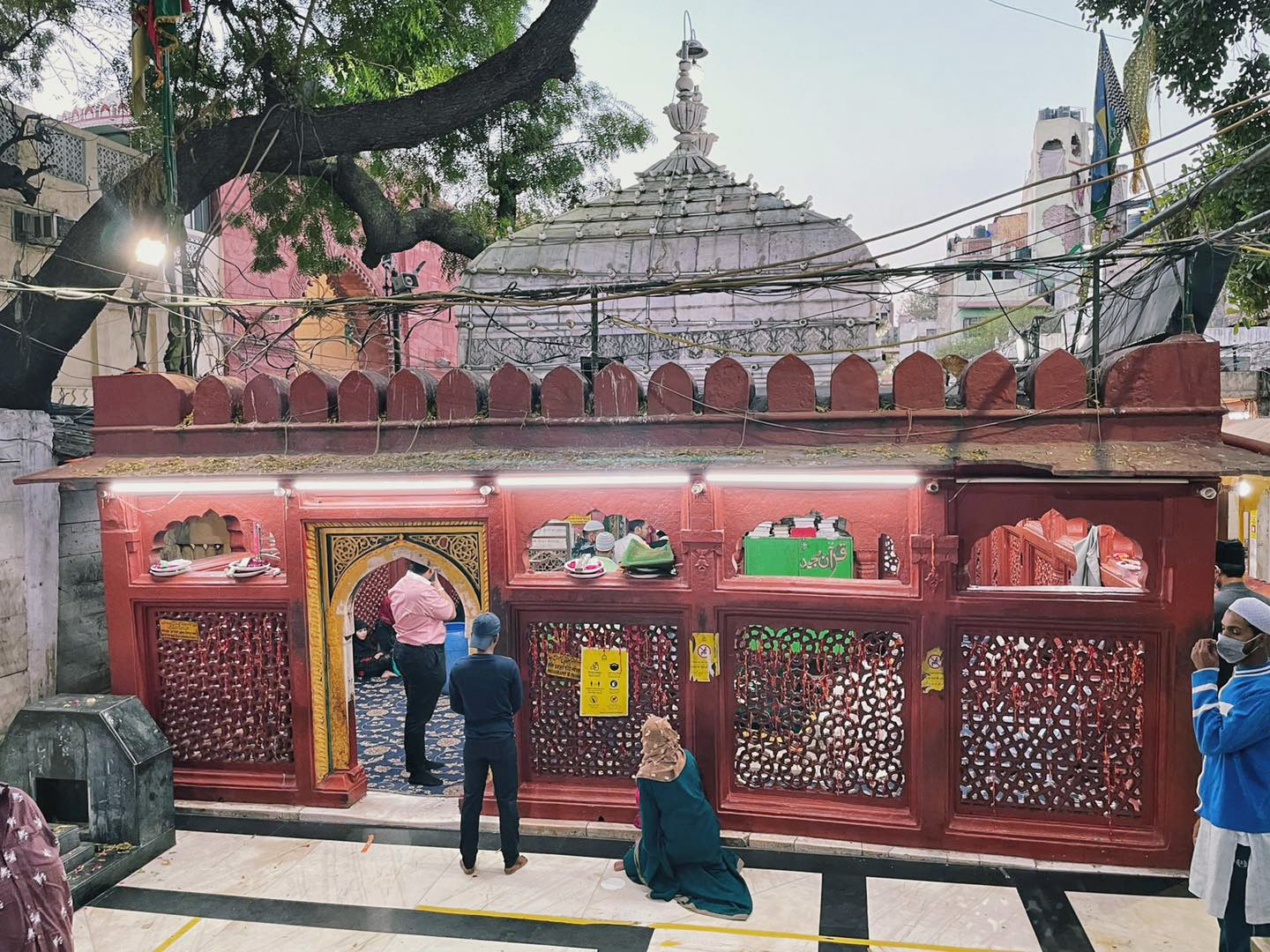
At the sight of the holy sandals, Khusrau’s eyes grew round with amazement. Thrusting forward a heavy chest, he exclaimed, “I implore you, sir: have the goodness to accept these gold tankas and grant me the treasure you hold in your hands.” Poet and farmer went their separate ways in the morning, each eternally indebted to the other.
In Delhi, Amir Khusrau took himself straight to his master carrying the sandals on his head. Bowing, he humbly extended his tribute. The Sultan of Saints asked, “Turk Allah, how much did you pay for these shoes?” Khusrau answered, “The whole of my meager wealth, Huzur.” Hazrat Nizam ad-Din smiled and observed, “You bought them cheap.” With eyes lined with tears, Khusrau replied, “Had I paid with my life they would still have been cheap.”
An Addendum
Legend has it that, when he realized the depth of Amir Khusrau’s love, Nizamuddin ordained that, when they died, they should be buried side by side.
“If you dig Khusrau’s grave anywhere else, he will break from the tomb to be with me,” said the saint.